Friday, 10 April 2009
Electric Underfloor Heating

Monday, 6 April 2009
Manufacture Wire Mesh Floor Heating Systems

Floor Warming
Calorique Floor Warming
Calorique's floor warming systems provide even, comfortable warmth that permeates a room. With floor warming, not only are surfaces warmed and people made comfortable, but the floor is warmed to just the right amount for it to be the most pleasant to walk upon.
NEW! Our customers swear by our clean, comfortable, affordable heating systems. Click Here to read just a few of their comments.
Conventional Heating System
Because radiant heat does not depend upon moving large volumes of air, dust and contaminants in the air and room are reduced.
Calorique's radiant floor warming systems are extremely energy efficient. Homeowners throughout the world use floor warming systems not only for their increased comfort levels, but also because they use as much as 20% less energy than other forms of heating, since all the heat energy is directed into the living space rather than heating the air along the walls.
Comfortable AND Economical
Calorique distributes OJ Thermostats ... the gold standard worldwide. Sensing both air and floor temperatures, these thermostats provide optimum comfort with optimum energy efficiency.
New! Warming System for Laminate Flooring
So Easy to Install ... and So Comfortable!
Laminate flooring is attractive, durable ... and cold. Warm it up with Calorique's new Laminate Warming System! Installed quickly and easily under virtually any laminate flooring, the even warmth generated by our low-powered warming elements will make every room it's installed in your favorite.
Elements come prewired in standard sizes making specifying and installing a breeze.
ThermoWeave™ In-Floor Warming System
ThermoWeave Goes Anywhere!
ThermoWeave is the new advanced heating system for your home, office, industrial space … anywhere that needs heat!
ThermoWeave’s exclusive double-insulated, all-metal heating ribbons gently warm your floors to distribute heat evenly throughout the living space.
And installation couldn’t be easier! Just lay down insulation and roll out ThermoWeave mats on an existing floor, then finish the surface normally. ThermoWeave is approved for installation under any type of floating floor, including laminates such as Pergo®! You can even embed ThermoWeave within concrete or tiling adhesive for use in bathrooms and kitchens!
Installed Warming Elements
ThermoWeave is ideal for houses and high rise apartment buildings. Each room is individually controlled with an air and floor sensing thermostat assuring optimal comfort. A plus for apartment building owners is that electrical consumption can be directly billed to the occupant removing a drain on your resources!
UL Listed and carrying an industry leading 15 year warranty, you can forget about maintenance. ThermoWeave is a 100% solid-state system with no moving parts to break or wear out. There are no ducts to clean, burners to service, or fuel tanks that have to be replaced regularly. Once ThermoWeave is installed, it’s out of site and out of mind.
Warm Floors™ Under-Floor Warming System
Installed Warming Elements
Ideal for new construction and areas where access to the floor joists is possible, the Under-Floor Warming System is attached between the floor joists with a small, 2" (5 cm) air space between the elements and the floor surface.
Click Here to see how easy our Under-Floor Warming System is to install.
floor heating system, of welded mesh sheets,,Electric Floor Heating Systems

Electric floor heating is an affordable luxury that is now gaining popularity among homeowners. Including floor heating in bathroom, kitchen or family room remodels has been spurred on by the relatively recent introduction of easy-to-install electric systems. Manufacturers, such as WarmlyYours, EasyHeat, and Delta-Therm among others, have developed electric applications that are well suited for even the most novice DIYer.
The method of installing an electric floor heating system is similar to that of a floor covering installation and is performed using many of the same tools. With a little care, and careful observance of the following instructions, a first time installer should have little difficulty completing their floor heating project. However, installation of the floor heating thermostat and final electrical hook should be performed by a licensed electrician.
STEP BY STEP INSTRUCTIONS
STEP 1: GATHER TOGETHER REQUIRED INSTALLATION TOOLS
The following materials will be used during system installation and should be gathered prior to starting your floor heating project:
Ohm Meter
Utility Scissors and Knife
Duct Tape, Hot Glue Gun or Staple Gun (for holding the system in place)
Broad Tip Marker and Tape Measure
1/4" or 3/8" Square Notched Trowel
Latex Modified Thinset Cement
STEP 2: ROUGH IN ELECTRICAL WORK
A dedicated circuit is recommended for your floor heating system. This recommendation is in accordance with the National Electrical Code (NEC). Local codes may differ, so always consult with a qualified electrician first.
When installing the floor heating thermostat, install a 4" square 2 1/8" deep electrical box with a single mud ring. Electrical boxes are typically placed 4' to 5' off the floor. For electric floor heating installations that require a floor sensor, the installer should include two pieces of 1/2" conduit from the electrical box to the base of the wall (see diagram).
STEP 3: TEST POSITION YOUR SYSTEM ON THE SUBFLOOR BEFORE INSTALLING
Test position and fit your floor warming system on the subfloor to determine where you would like to have the floor warmed for your personal comfort.
For ready reference during final installation, use a permanent marker to indicate where you would like to position your system on the subfloor, as well as any planned cuts or turns on both the subfloor and the system itself.
STEP 4: CHECK SYSTEM OHM READING PRIOR TO INSTALLING
Before installing your floor heating system, you will want to check the Ohm resistance between the two power conductor wires to make sure that no breaks or shorts have occurred that could affect your system's performance. Follow manufacturer’s recommendations regarding the proper variance and the frequency of Ohm readings.
STEP 5: SECURE SYSTEM TO SUBFLOOR
On the clean and prepared subfloor, position your system exactly like it is to be installed. Run the power leads back to the power supply without crossing over the heating element.
Complete any necessary cuts and turns to fit the electric floor heating system into place. Only the system's mesh backing should be cut. Never cut the heating element.
If you are installing a thermostat or control that includes a floor sensor, place the sensor head under the fiberglass mesh and center it between the heating elements. Once positioned, hold the sensor in place with a bit of hot glue, duct tape to prevent it from moving during the installation.
Once the system and power leads are in place, affix each to the subfloor using hot glue or duct tape.
Note: Hot glue will not harm the heating element or power leads and may be used to hold them in place. If using a staple gun, apply staples to the fiberglass mesh backing only. Never staple near or through the heating element or power leads.
STEP 6: COVER THE SYSTEM IN THINSET CEMENT
You are now ready to apply a thin, skim-coat layer of latex modified thinset cement over your floor heating system. Before applying thinset cement over your system, attach the circuit check installation tool* to the two (2) power lead wires as shown to ensure trouble-free installations. Make sure that the tool is properly attached to the power leads. An alarm will sound should your system's heating element or power leads be nicked or cut during the installation process allowing for immediate identification and repair.
*Note: Not all electric floor heating manufacturers provide a circuit check tool.
Using the flat edge of your trowel, carefully apply a thin skim-coat of thinset cement over the floor heating system and allow it to dry. Be careful not to nick the heating element or power leads with the trowel.
Once the thinset has thoroughly dried, you will be ready to install your floor covering. We recommend a 1/4" or 3/8” notched trowel to ensure sufficient coverage of thinset for the application of your tile or stone floor.
STEP 7: ELECTRICAL POWER HOOKUP
Use a licensed and qualified electrician, familiar with local electrical codes, to perform your system's final electrical hook up.
STEP 8: WAITING PERIOD BEFORE SYSTEM OPERATION
Before operating your new electric floor heating system, you must wait until the thinset cement has fully cured to the manufacturer’s specifications (usually 2 to 14 days).
Now, you are ready to experience the radiant warmth and comfort of your new warm floors!
For more information on electric floor heating systems, please visit www.WarmlyYours.com.
Underfloor heating
Underfloor Heating (UK) are specialists in the supply, design and installation of electric underfloor heating systems for industrial, commercial and domestic use. Underfloor Heating UK can supply a total solution for any type of electric under floor heating. Under floor Heating UK supplies the full range of eLine, Devi and AHT matting and cable products. Underfloor Heating UK is part of the Elements group of companies which supplies heating solutions and designs via its web sites: Electric Underfloor Heating, Elements Shop, Underfloor Heating Projects UK, Underfloor Heating UK and Elements Trade.
Underfloor Heating UK is a subsidiary of CJ Electrical (Ipswich) ltd , created to distribute Quality products via the internet and by an external technical sales team. Underfloor Heating UK are an accredited partner of Devi™, distributing the full range of Devi™ and associated underfloor heating products. Based in Suffolk, covering national & international distribution.
Improving Internet Product Supply
Moving forward with quality products that can be easily purchased at your own convenience, Underfloor Heating UK recognises the importance of supplying quality products at reasonable prices, with full technical advice and planning service supported by a 30 day money back guarantee & free of charge delivery to your door.
Striving to Ensure Customer Satisfaction
We here at Underfloor Heating UK take very seriously the concept of customer service, striving to ensure your purchase is based on an educated & informed decision. Understanding all the benefits and advantages of our product range, we believe is essential to customer satisfaction, particularly when purchasing from a company selling via internet. We aim to achieve this and are continually striving to improve our customer service.
Underfloor heating - Wikipedia, the free encyclopedia

Building Material Concerns:
Selection of wood flooring species, milling (quarter sawn or plane sawn) acclimation period, regulation of relative humidity for dimensional stability and surface temperatures for comfort.
R values of floor assemblies
Control/expansion joints and crack suppression in concrete and tiled surfaces.
Emissivity of surfaces.
Curing times and temperatures for poured floors (concrete, lightweight toppings).
Control System (see Hydronic heating systems):
Fluid temperature in heating and cooling plant.
Fluid temperature in distribution network.
Fluid temperature in the pex piping systems. A function of the spacing, load (Btuh/sf), upward and downward losses and floor r value.
Operative temperature (average of mrt and dry bulb).
Surface temperatures for comfort, safety, and material integrity.
Cost of hot water systems
Although it can be more expensive to install than radiators (it can be comparable due to the increasingly competitive market), wet underfloor heating often proves more economical in the long run, particularly in well-insulated larger properties. Energy savings of up to 40% can be achieved compared to conventional heating systems if a condensing boiler or solar thermal system is installed, but even with a standard boiler up to 15% energy savings are normal [3]. The efficiency of condensing boilers is enhanced thanks to water returning at a lower temperature.
By employing full lengths of piping without any joints, wet underfloor heating loops are practically maintenance free. The piping used can have a lifespan of up to 100 years. Reliable materials are critical because repair is difficult. The central heating equipment, pumps, and controls, like others, requires periodic maintenance and replacement.
Electric floor heating systems
Electric floor heating systems have very low installation cost for smaller spaces (1-5 rooms) because they are easy to install and have a very low start-up cost (a thermostat is all that is required and costs only about $100-$200). Although electric floor heating systems work well as a primary heat source, most systems are installed in the bathroom to add comfort and warmth to cold tile.
Electric floor heating systems are also typically installed in kitchens, bathrooms or in rooms that require additional heat (such as a cold basement, an addition or a kids' playroom, low voltage electric systems are suitable for entire home installations. Rooms can be zoned with their own thermostat and programmed around the schedule of the inhabitant, this can add efficiency to an entire homes energy consumption.
Another advantage of electric underfloor heating over a warm-water system is the floor build up/height. Floor build up can be as little as 1 mm. The electric cables are usually installed onto an insulation board or directly onto the subfloor or padding (under carpet or laminate); then the floor covering is placed directly over the heating system or thinset.
Electric underfloor heating also benefits from faster installation times, with a typical installation only taking half day to a day depending on size to install. Also warm up times are generally a lot quicker than "wet" systems because the cables are installed directly below the finished flooring making it a direct acting heat source rather than a storage heater.
Electric system are supplied in several different forms. They can be one long continuous length of cable with the consumer having to weave the cable up and down the floor at a pre-determined spacing and making a return loop to complete the circuit, or they can be provided in mat form, where the heating element is pre-formed in a mat that rolls out onto the floor. Most high voltage cables have a built in return, meaning that you have one end to connect. Most low voltage technologies consist of a loop with a start and end. With the introduction of the built in return came the “cable mat”. Cable mats have added to the ease of installing a floor heating system by having the heating cable already pre-spaced on to a nylon mesh. Cable mats however can cause issues for odd shaped spaces where a free rolled cable may be able to cover in a more custom pattern. Also to take into account is longevity of a system considering high voltage and low voltage technologies.
One technique is to lay the heating cable directly onto an insulated concrete floor and then apply tile on top of it. Where time-of-use electricity metering is available, this type of system can be turned on at night when electricity rates are low, and then allowed to warm the house during the day by relying on the heat energy held within the thermal mass of the concrete.
Sometimes, in order to minimize floor buildup, a low voltage bronze screen or a carbon film heating element is used. Carbon film systems are normally installed onto a thin insulation underlay (approx 6mm) to reduce thermal loss to the sub-floor. Carbon film is used under various floor finishes, traditionally laminate flooring or engineered wood. Vinyls, carpets and other "soft" floor finishes can be heated using carbon film elements or low voltage bronze screen elements, provided a suitable overboarding system is used.
In comparison to combustion/hydronic systems, electric systems can be more efficient, if only the efficiency of the equipment in the building is considered. However, as discussed in the article on electric heating, the efficiency of generating electricity from fossil fuels is low. Electric systems however are either on or off and do not require idling times. Electric systems also have the advantage of needing no maintenance and can more easily be controlled to run when and where they are needed. However, electric underfloor heating systems cannot provide cooling in summer.
Manufacture WELDED MESH SHEETS
Address Anping County Wire mesh industry-districts
Manufacture WELDED MESH SHEETS used in Underfloor Heating and Floating Floor from CHINA.
Anping Xincheng Hardware Mesh Co., Ltd is sited in Anping County of Hebei Province which is the famous Wire Mesh Land of China. This company is professionally engaged in production, processing and sales of various wire mesh products.
Main Products:
We have first-class production equipment, strong R&D capability, rich experiences and full inspection means to provide full range of wire mesh and wire products for worldwide customers. Industrial Mesh products we offer include Welded Mesh panels Series, Welded Wire Mesh Series and Wire Mesh Fence etc.
Anping Xincheng Hardware Mesh Co., Ltd follows the vision of Seeking First Quality & Building Good Reputation in doing business and tries to provide quality products and excellent services for our customers. We are now exporting to the USA, Europe, Southeast Asia and some other countries. We would like to establish long-term business relationship with you. Welcome to contact us.
Sunday, 5 April 2009
eco hometec - Hot Water Heating & Storage

Hot Water Storage includes, Thermal Stores, Buffer Tanks, Single & Multi-coil cylinders
Buffer Tanks
Buffer tanks and thermal stores are used to store heated water. The source of this heat can be from one or a combination of the following. A conventional oil or gas boiler, heat pump, thermal hot water solar system, or even surplus electricity from a wind turbine or photovoltaic array powering an immersion heater.
Buffer tanks are very useful to system designer of a low energy heating system. They allow them to store energy from different sources to be used later to heat hot water or the buildings underfloor or conventional heating system. They also help to reduce boiler or heat pump cycling, and maintain adequate flow rates through appliances, all of which are critical in maximizing efficiencies. eco hometec freestanding buffer tanks are available in capacities form 200 to 700 litres.
A buffer tank is recommended to ensure trouble-free heat pump operation. It acts as a bridge during electricity supply shutdown periods and as separator between the volume flow in the heat pump and that in heating circuits.
We can supply buffer tanks fitted with a heat exchanger for boosting the DHW with solar energy. These are used in our designs were solar water heating is used to heat the central heating system, typically a low temperature ecotherm underfloor heating system.
Duotank Stainless Steel Unvented Hot Water Cylinders
130, 160, 210, 240, 300 and 500 Litre High Performance Stainless Steel Hot Water Cylinders. Traditional coil-based cylinders are often hard-pressed to keep up with demand. Duotank technology represents a significant advance in the science of hot water storage, so much so that, in virtually every situation encountered, the coil-based cylinder is completely out-classed.
The domestic hot water is heated and stored in a stainless steel vessel, which is immersed within a primary tank – a principal known as a tank within a tank. This method provides not only exceptional efficiency, but ensures thorough and even heating of domestic hot water.
The eco hometec Duotank range of high performance hot water tanks are ideally suited for providing volume hot water for a variety of domestic and commercial applications. The principal of design and the quality and type of material used, creates a product, which offers not only exceptional performance, but also with the important advantage of long-term reliability, internal hygiene and virtually maintenance free operation. The Duotank range of hot water tanks are listed in the Water Byelaws Scheme's Water Fittings and Materials Directory and are approved for installation.
The incredible heating surface area of the Duotank stainless steel cylinder from eco hometec ensures fast and efficient hot water recovery times.
Duotank Features
Utilises Duotank Tank-in-Tank technology for fast heat up and rapid recovery
Two different models available: SLE & SL (SLE includes 3kW immersion heater, located in the bottom of tank in the primary water)
6 models of 130, 160, 210, and 240 litres (SLE), 320 and 420 litres (SL)
High quality 50mm polyurethane insulation
Low heat loss (only 8.6°C over 24 hours for the SLE240)
Hard-wearing polypropylene finish
Stainless steel construction - no need for sacrificial anodes
Vented or unvented use, with mains pressure SystemPak (valves) available
Large heating surface area means reduced boiler cycling
Duo Hot Water Tank
To open the Duotank Stainless Steel Unvented Hot Water Cylinders technical manual click here.
eco hometec Solarcyl Twin Coil Stainless Steel Hot Water Cylinders
Solar thermal water heating is a very simple concept. The sun's energy is absorbed into the solar collector on the roof of the property. The collected solar energy heats a water/glycol mix that is pumped between the collector and the solar heating coil in the eco hometec Solarcyl, which heats the water contained in the cylinder.
The system is normally controlled by a programmable solar controller that simultaneously measures the temperature differential between the cylinder and the collector. Sensor points are provided in the eco hometec Solarcyl to allow this measurement. A target temperature is set on the controller which the solar system will aim to achieve provided solar energy is available. During the summer months, up to 100% of hot water can be produced by solar energy. Even in winter, solar can provide a pre-heat to the water which can reduce traditional energy consumption by up to 30%. Over a full year, up to 70% of hot water can be generated using solar energy. At certain times the energy available from the sun will be insufficient to fully heat the cylinder to the desired temperature.
In these instances an auxiliary power source will be required to maintain the desired temperature of the cylinder. eco hometec offers two types of Solarcyl. The twincoil has an upper auxiliary heating coil for connection to a boiler. The solar direct has an additional immersion heater above the solar coil and is designed for properties with electric heating.
eco hometc Unvented Hot Water Cylinders
The eco hometec Solarcyl is a stainless steel unvented hot water cylinder which has a 25 year guarantee.
Unvented cylinders are connected and supplied directly from the cold water mains supply, resulting in hot and cold water being delivered to all outlets within the dwelling at mains pressure. Fast filling baths and power showers are a reality. Feed and expansion tanks associated with a conventional cylinder and tank installation are no longer required.
eco hometec unvented cylinders offer high performance water heating and hot water delivery flow rates of up to 55 litres per minute. The very large surface area of the solar heating coil means that the maximum heating advantage can be achieved from the solar system.
Unvented cylinders are now commonplace in the UK and are taking over from traditional gravity fed (vented) cylinders as the product of choice for many installers in both new build properties and retro-fit units in existing properties.
To open eco hometec Solarcyl technical manual click here.
Please browse our website for more information about eco hometec and our range of Underfloor Heating, Heat Pumps, Solar Panels & Condensing Boilers then click here to submit your building plans, contact us on Freephone 0800 8620278 to speak to one of our team or e-mail us on sales@eco-hometec.co.uk.
Laing Introduces Compact Hydronic Heating Products for Floor, Wall and Radiant Applicationsair Services
Chula Vista, CA (PRWEB) March 16, 2007 -- Laing Thermotech recently introduced an innovative line of hydronic heating products that are suitable for retrofit installation and new construction. The new equipment has a compact design that can easily be installed for floor, wall and radiant heating -- and at a lower cost of operation than traditional systems, according to Scott S. Shimer, Laing's CEO.
"Our new hydronic heating system incorporates Laing's patented spherical motor pump for excellent circulation and known reliability," says Shimer. "The integrated spherical motor ensures an even temperature distribution in the whole surface and a constant, comfortable temperature level in the floor heating area."
The integrated spherical motor ensures an even temperature distribution in the whole surface and a constant, comfortable temperature level in the floor heating area.
Laing currently offers two kinds of hydronic heating products: the MOH 1 and MOH 2. The MOH 1 provides a single or dual zone mixing module for connecting floor heating surfaces with up to 400 square feet for one and two-pipe systems. It's comprised of a mixing base unit, spherical motor pump with on/off-switch and a 6-foot power cord, a pre-adjustable control valve, room temperature-guided control, mounting bracket for left or right sided connection, an adjustable bypass for connection to outdated one-pipe systems and a venting device. The MOH 1 also comes with an over-temperature protection device that prevents a flow with temperatures higher than 131º F through the floor heating loops. This helps eliminate potential damage to the floor.
And with the MOH 1, mixing unit floor hydronic heating systems with up to two circuits and up to 400 square feet can be easily connected directly to boiler/radiator circuits. Even old boiler systems with high supply temperatures up to 230º F can be connected to a floor heating system. The MOH 1 is designed for oxygen-proof floor heating systems. In addition, MOH 1's KF model is especially suitable for bathrooms and other humid areas due to the non electrical thermostat with remote sensor.
MOH 2 is a low-temperature heating system that can be connected to a broiler loop using a multi-zone mixing module. This product, which is appropriate for floor heating, wall heating and snow melting applications, has control valves and circulators for the low temperature loop incorporated right into the mixing module. It also features preassembled substations that are available with manifolds and expansion tanks in a cabinet or board mounted.
In addition, the MOH 2 offers a space-saving design that is easy and low-cost to use. It can be employed in systems with three to 12 individual zones--up to 2,400 square feet. And as another advantage, the MOH 2 product can be connected directly to the boiler loop, so a separate low temperature loop from the boiler to the floor heating manifold isn't needed. There's also no need for the boiler manifolds and additional mixing valves. And a boiler isn't necessary if the MOH 2 mixing module is used in individual installation.
The MOH 1 and MOH 2 are both designed to be easy to install, maintain and service. They are also designed to be efficient and cost-effective for users to operation. The innovative MOH 1 and MOH 2 hydronic heating systems expand Laing's extensive line of cutting-edge products for consumer, commercial and industrial use.
Laing is an industry leader that developed the first practical do-it-yourself Instant Hot Water circulation system. The company's products range from energy-efficient, fractional-horsepower pumps to flow-through heaters to compact computer cooling systems. For additional details about Laing's hydronic heating equipment and other products, visit www.lainginc.com.
About Laing Thermotech Inc.
Laing Thermotech Inc. is part of the Laing family of companies, which originated in Stuttgart, Germany in the early 1970's with the introduction of unique solar and pump products. Laing employs innovative technologies to create product designs that are reliable, compact, less expensive to install and operate, and easier to service in the field. The company holds a large number of registered patents in consumer, commercial and industrial markets. Its products are sold worldwide, with sales and distribution operations in Germany, Japan and the United States, as well as a manufacturing, sales and distribution facilities in Hungary.
For more information, contact:
Bob Hutslar, National Sales Manager Plumbing & Heating
(619) 575-7466 Ext. 112
The Chartered Institute of Plumbing and Heating Engineering
The Institute provides a professional home for qualified owner managers, sole proprietors, journeymen, designers, lecturers, inspectors and consultants. All corporate members (Fellows, Members and Associates) agree to abide by a five point Code of Professional Standards, which requires them to act professionally, competently and responsibly. A Professional Standards Committee meets monthly to consider possible contravention of the Code.
The CIPHE has a total current membership of over 12,000 including 260 manufacturers and distributors, which support its work as Industrial Associates. Whilst the majority of members live in the UK, some 750 are resident in Hong Kong and a further 300 are resident in over 30 other countries. In Britain there are some 50 active local Branches grouped within six areas.
Suitably qualified Institute members also enrolled as Registered Plumbers, are recognised by the Secretary of State, DEFRA, as "Approved Contractor Persons" under the Water Supply (Water Fittings) Regulations 1999 in England and Wales and the Water Byelaws (Scotland) 2000.
The main dissemination of information is via the bi-monthly magazine, P&HE (PLUMBING AND HEATING ENGINEERING), which gives news of developments and technical innovations as well as CIPHE activities at national, area and branch levels. The latest edition of the widely acclaimed Plumbing Engineering Services Design Guide was published in July 2002.
The Institute is a member of the Construction Industry Council - www.cic.org.uk - and a licensed member of the Engineering Council (UK) - www.engc.org.uk. The Institute is also a founder member of the Plumbing and Heating Industry Alliance - www.phia.org.uk
Internationally, the Institute acts as Secretariat to the World Plumbing Council - www.worldplumbing.org - which is developing links with the World Health Organisation and other United Nations agencies.
History
The following are some key historical facts about the Institute.
The Institute was founded in 1906 and incorporated as a company limited by guarantee in 1907 by the National Association of Master Plumbers. Known then as the Institute of Plumbers, its original objectives related to development of both the industrial and technical aspects of the plumbing trade. Membership was restricted to plumbers in business.
In 1925, what is now the Association of Plumbing and Heating Contractors (APHC), was established to take over industrial and commercial aspects leaving the Institute to concentrate on education, training and technical matters.
In 1957, the Institute's constitution was revised and its title changed to the Institute of Plumbing (IoP). Membership was extended to any individual holding technical qualifications irrespective of their position in the Industry.
In the late 1960's discussions began between the Institute and the Registered Plumbers Association (RPA) to bring about a merger of the two bodies. The main role of the RPA was to manage the Register of Plumbers on behalf of the Worshipful Company of Plumbers - the origins of which date back to 1365.
The amalgamation of the IoP and RPA took place on 10 January 1970. The new Institute was charged with the task of further developing technical and educational work; the recognition of qualified plumbing professionals and the pursuit of better standards.
In 1979 the Institute became a registered educational charity in recognition of its work in the public interest. 1986 marked the centenary of the Register of Plumbers which was started by the Worshipful Company on 21 July 1886 to identify competent and responsible plumbers in the absence of any statutory regulation in the UK - a position which still exists today. The centenary was celebrated by a gathering of over 700 Registered Plumbers at Guildhall, London where special Centenary Certificates were presented.
In 2000, to mark the new millennium, the Institute was granted Arms by the College of Heralds. The motto "Competence and Commitment" aptly describes the Institute's work as a professional body.
In March 2002 the Institute asked historical publishers James and James Ltd (J&J) to write a definitive history of the Institute to coincide with its centenary in 2006. In turn J&J commissioned Nigel Watson, a renowned historical writer, to produce the text.
Nearly four years later, ‘Competence and Commitment’ – an illustrated history of the Institute - was launched at a press conference held at City & Guilds headquarters on 8 December 2005. Speaking at the launch, Chris Humphries CBE, Director General of City & Guilds, said that he was pleased to have written the foreword to the book and proud to be the IPHE Centenary Year Patron. Chris Humphries said “Nigel Watson has done a great job in making ‘Competence and Commitment’ a very good read. It’s a fascinating story which will be of interest not only to plumbing professionals around the world but also to those who don’t have lead running through their veins!”
History of underfloor heating
In pre-Roman times underfloor heating was a rare and somewhat radical technology in a world that typically relied on open fireplaces. But not only were fireplaces inefficient in warming an entire room, they were dangerous as well from the risk of fire and smoke inhalation.
Mediterranean
Roman world
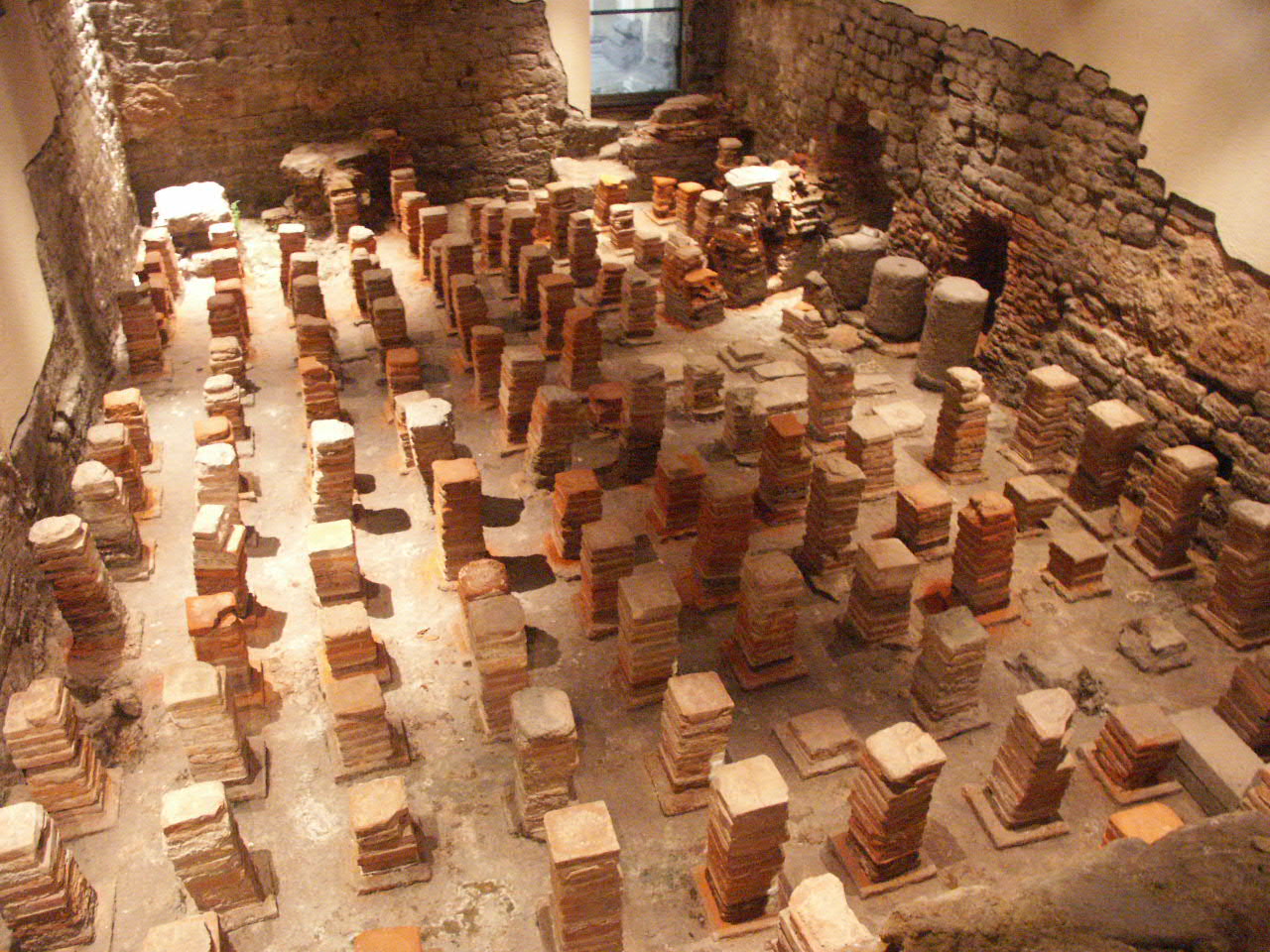
Caldarium from the Roman Baths at Bath, England. The floor has been removed to reveal the pillars of the hypocaust.
Underfloor heating was first used by the Romans. Initially the preserve of the rich, underfloor heating became increasingly commonplace in public buildings and villas, particularly in the colder regions of the Roman Empire.
The Roman system was based on hypocausts, comprising ducts that underlay the floor (itself built on raised brick piles) and flues that were built into walls. Hot air or steam from fires circulated up through this system, warming the floor and walls, with heat passing into the rooms.
More specifically, the floor was laid out as series of concrete slabs supported by columns of layered tiles, with a furnace at the bottom of one exterior wall. By placing the fire here, the draught would take the heat under the floor, and up through the walls to chimneys located in the corners of the room. The height of the stack of tiles was about 2 ft (60 cm) as this was found to be the most efficient height for the air to travel through.
Once the air had passed under the floor, the air was drawn into the walls and up the flues by the action of the hot air already rising in the flues creating a partial vacuum and so pulling the air below into the walls. The walls were very often made of bricks with two holes horizontally through them. This had the effect of passing the air through the walls and into the flues, thereby warming the walls also.
In the Roman baths, the furnace was placed next to the hottest room caldarium in which three walls of this room were heated so that the room reached a temperature of up to 120 °F (50 °C). The warm room tepidarium only had one wall heated which made this room cooler than the caldarium.
The furnace was the heating source of the system and this was placed on the outside of the house, below the floor that ran under the room that was to be the hottest room in the house. One room was always hotter than the rest, as the air flowing under the floor would naturally lose some of its heat as it was traveling under the floor.
The Roman underfloor heating system was a labor intensive device that required constant attention to feed the fire and remove the ashes. (Again, it was originally only the wealthy that could afford to have it.) The fire would need regular attention from a household worker who would have to rake out the ashes with a long handled tool and, using the same tool, push new fuel into the fire.
The fuel was mainly small branches and twigs (up to about 3 in/76 mm in diameter and up to 2 ft/610 mm long), which were placed 2–3 feet (610–910 mm) into the furnace opening. This would allow air to be drawn in and around the wood and so made sure the air flowed freely. Logs were not used as these burned too slowly to be effective, and too many would block the passage of air. The height of the fire was restricted to around half the height of the opening so that air could flow through the flames and so accelerate circulation and increase heat output. This was essential in the baths, where the maximum amount of heat had to be generated.
The hypocaust was recently voted the most important heating invention ever by the British HVAC industry.[1]
Islamic world
The hypocaust continued to be used in the Mediterranean region during late Antiquity and by the Umayyad caliphate. By the 12th century, Muslim engineers in Syria introduced an improved central heating system, where heat travelled through underfloor pipes from the furnace room, rather than through a hypocaust. This central heating system was widely used in bath-houses throughout the medieval Islamic world.[1]
Korea
In contrast to the eventual disappearance of the Roman underfloor hypocausts, underfloor heating has remained in use for millennia in Korea, where it is known as ondol. It is thought that the ondol system dates back to the Koguryo or Three Kingdoms (37 BC-AD 668) period when excess heat from stoves were used to warm homes.
Ondol continues to be a typical feature of the South Korean home, and is widely credited with making possible distinctively Korean customs such as removing one's shoes upon entering a home and sitting on its floor. (The "sitting culture" brought about by ondol influenced the design of hanbok, the traditional Korean outfit; hanbok trousers are loose and have enough room for people to easily bend their knees and sit for long periods of time, and traditional shoes were also made to be easy to take off and put on compared to Western shoes.)
In fact, when Western forms of heating, such as blowers venting hot air, became more widely used in Korea, many families began to miss the ondol system that had long been an integral part of Korean life. As a result, developers in Korea during the 1990s began to discard Western forms of heating, and started to incorporate ondol in new housing developments. Even the most modern Korean hotels offer guests the option of selecting a traditional ondol room with no beds.
Korean ondol technology
Ondol, literally meaning "warm stone", comprised three main components: a fireplace or stove, which is also used for cooking and located below floor level; a heated floor underlaid by horizontal smoke passages; and a vertical chimney, located lower than the roofline, to provide a draft.
The heated floor comprised a network of underground flues that transported heat from the kitchen to each room. These flues were covered by thin, flat, wide stones two or three inches thick called kudul that lay underneath the floor. Kudul, literally meaning "fired stone", was covered with yellow earth, and the floor was leveled. To top it off, several layers of yellow paper sheets were pasted on the floor. This process was efficient since the heat and smoke generated during cooking would be transported automatically to each room in the house. Usually the kitchen would be built at a lower level (about one m), and the heated rooms would be in an elevated position to allow the flues to run underneath. Notably, with just one heating the floors would retain their warmth for extended periods, ranging from more than 30 days to three months depending on the design of the flue structure.
The traditional ondol rooms found in the northern part of the Korean Peninsula differed somewhat from those in the south. In the north the ondol-heated room and the kitchen were not separated by a wall. Heat from both the fireplace and the ondol floor kept the room warm. In the south, a wall separated the kitchen from the living room, preventing the smoke from disturbing people sitting there. Also, in a room heated by ondol, the floor at the far end of the room tended to be cool. (Elders such as grandparents or parents as well as guests were invited to sit in the warmer area as an expression of respect.)
The continuing legacy of ondol
In the early 1900s, when the American architect Frank Lloyd Wright was building the Imperial Hotel in Japan, he was invited to the home of a Japanese nobleman. There Wright found a room that was different from typical Japanese rooms, with a warm floor covered with yellow paper -- a Korean ondol room. The Japanese gentleman had experienced ondol in Korea and, once back in Japan, had an ondol room built in his house. "The indescribable comfort of being warmed from below" impressed Wright.
Wright decided then and there that ondol was the ideal heating system and began incorporating it in his buildings. Wright invented radiant floor heating, using hot water running through pipes instead of hot air through flues. In Korea, ondol has likewise been adapted to modern technologies and changes in fuel. Modern Korean homes and apartments are built with heating pipes embedded in floors that are typically concrete covered with vinyl or oiled papers. Heated water circulating through the pipes, warmed by a gas or oil boiler, has replaced heated air, minimizing the danger of carbon monoxide poisoning or burns.
With its modernization, ondol has received international recognition and has become increasingly popular abroad, particularly throughout Asia. Moreover, a new type of ondol product, to which Western living patterns have given birth, is increasing in sales outside of Korea. Tolchimdae, meaning stone bed, has emerged as a hot seller in the furniture market beginning in 1998. Tolchimdae, which first appeared in the market in the early 1990s, is a stone bed filled with either carbon film or copper coils that are electrically heated. Its development was based on the concept of the ondol system. The new product is especially popular among older customers who want to enjoy ondol, but on a Western-style bed.
Radiant Heating, radiant floor heating products
Radiant Heating is a system to heat and cool buildings and homes that relies primarily on radiation heat transfer. Typically, heated or chilled water is circulated though floor or ceiling panels to condition the space (hence the name radiant heating).
Radiant heating has been used for centuries. The Romans channeled hot air under the floors of their villas. The Koreans channeled hot flue gases under their floors before venting them up the chimney. In the 1930s, architect Frank Lloyd Wright piped hot water through the floors of many of his buildings. Some home builders' surveys have shown that, if given a choice, most new home owners prefer radiant floor heat over other types of systems.
All Items are shipped from our office in Oklahoma City, OK, in less than 24 hours. We can provide technical assistance in all departments and can help you on your projects. If there are items you don't see chances are we have it in stock.
Most people who own radiant floor heating feel that the most important advantages are comfort and quiet operation. Radiant floor systems allow even heating throughout the whole floor, not just in localized spots as with wood stoves, hot air systems, and other types of radiators. The room heats from the bottom up, warming the feet and body first. Radiant floor heating also eliminates the draft and dust problems associated with forced-air heating systems.
Even heat distribution may result in lower heating bills. With radiant floor heating, you may be able to set the thermostat several degrees lower, relative to other types of central heating systems. This is because the entire surface of the floor radiates about the same amount of heat that the human body does, making the occupant feel warm even though the air temperature might be only 65ºF (18ºC). It also radiates this heat for a long period of time. Radiant systems may result in less infiltration of outside air into the house compared to houses with forced-air heating. Radiant floor heating proponents claim that fuel savings of 15% to 20% over forced air systems are possible. However, recent reports suggest that this may not be the case, since occupants may not be comfortable with a "low" thermostat setting and thus not set it lower.
Radiant floor heating also allows for lower boiler temperatures, which may result in the boiler lasting longer (a 45 year life is not unusual). Radiant floors operate between 85-140ºF (29-60ºC), compared to other hydronic heating systems' range of 130-160ºF (54-71ºC).
To some, the greatest advantage of radiant floor heating is aesthetic. The system is "invisible." There are no heat registers or radiators to obstruct furniture arrangements and interior design plans. Radiant floor systems also eliminate the fan noise of forced hot air systems.
WIRE MESH Warmafloor systems

Warmafloor systems can be incorporated within load bearing structural floors in a variety of applications from factories and warehouses to sports complexes. There are generally two types of floor construction, those of a simple concrete slab construction and those which incorporate a re-enforcing wire mesh grid at mid level in the floor. The floor construction generally comprises a compacted and level hardcore bed which is sand blinded flat. Wire mesh is then installed either on the floor insulation in the case of simple concrete slad floors,or,in the case of structural floors
at the required level in the slab.
Low Profile Screed Floors
Pocketed Polystyrene reduces the overall floor build up thickness, reduces the quantity of screed and improves upon traditional underfloor heating performance.
In a screeded floor, many UFH suppliers require the heating pipe to be fixed to the top of the insulation. The depth of screed must then be the minimum depth of screed above the top of the pipe, plus the pipe diameter, plus an allowance (5-10mm) to allow for the fact that the pipe is not held down tight to the top of the insulation apart from where the fixings are.
It is also worth noting that the presence of the pipe on top of the insulation causes the suspended particles within the anhydrite screed to settle out, leaving a region directly above the pipe deficient in particles and prone to cracking. To compensate for this it is recommended that an additional 5mm of screed is used.
Many suppliers recommend the use of expanded polystyrene because of the cheap component cost, which has a poorer thermal conductivity (0.040W/mK) than other forms of insulation. Consequently the insulation itself needs to be thicker in order to achieve a target U value.
Expanded polystyrene is also open-cell and MUST be covered by a moisture-barrier before screed is placed on top otherwise the moisture from the screed will soak into the polystyrene and compromise its effectiveness as insulation. So there is an obvious issue with using staples to fix through the moisture-barrier as moisture will permeate through the holes created where the staples puncture it.
A typical floor build up is:
50mm
10mm
17mm
45mm
122mm
EPS
Gap Below Pipe
Pipe Diameter
Anhydrite Liquid Screed
Total Build Up From Sub Floor
OSMA Pocketed Polystyrene is manufactured from Knauf’s Polyfoam Floorboard, which is extruded polystyrene and has a better thermal conductivity value (0.029W/mK) than expanded polystyrene. Consequently a thinner layer of insulation can be used to provide the same U value.
By having the pipe set within the top of the insulation, the screed can be the same thickness as required over plain insulation.
A typical floor build up is:
35mm
40mm
75mm
XPS (With 15mm Pipe Set Within The Insulation)
Anhydrite Liquid Screed
Total Build Up From Sub Floor
By having the pipe set within the top of the insulation, the screed can be the same thickness as required over plain insulation.
A typical floor build up is:
35mm
40mm
75mm
XPS (With 15mm Pipe Set Within The Insulation)
Anhydrite Liquid Screed
Total Build Up From Sub Floor
75mm is the same thickness as a course of bricks. The greater thickness of the conventional build up can require an extra course of bricks for each storey, increasing the time taken to construct the building and its cost, in order to maintain the same internal floor to ceiling height.
The amount of screed required is also different. In the conventional pipe-on-insulation build up it is 45+17+10 = 72mm. With Pocketed Polystyrene, it is 40mm plus the amount required to fill the Pockets, equivalent to 4mm over the whole floor when the pipe is set at 200mm centres (or 2.5mm with pipe set at 300mm centres) = 44mm.
A saving of 28mm of screed per square metre, is equivalent to a saving of one cubic metre of screed for every 36 square metres of floor area, which is considerable. This also saves weight and reduces drying time.
Because of the considerably reduced thermal mass, approximately 44% less, of the floor, the UFH system is able to warm up more quickly from cold and respond more quickly to changes in demand temperature.
Pocketed Polystyrene is a Patented Product.
General Welded Wire Mesh Panel

Material: Low carbon steel wire, stainless steel wire and rebar wire.
Variety: galvanized, PVC etc.
Characteristics: even surface, firm structure, precise opening etc, it has the good property of corrosion-resisting and oxidation-Resisting.
Usage: It is widely used on building, food, agriculture etc. For example, it is used on reinforced concrete construction, floor slabs reinforcement, brick wall reinforcement, floor warming etc.
Manufacture aluminum foil mat used in floor heating

Drawing the viewer in with a sense of involvement, reality TV serials featuring property conversions by DIY enthusiasts, architects and interior designers have taken a strong foothold in the UK.
In Germany the concept has taken off too and, abound with handy tips for the homeviewer, formats such as "Live your wish - the House" on VOX, "Dreamhouse" in the Bavarian broadcast and "In Luck At Home" on RTL2 are increasingly popular.
"In Luck At Home" is a program that frequently focuses on families who, either through illness or adverse circumstances, are no longer able to revamp their homes and in the 53rd episode, the Dittrich family decided to install an electric underfloor heating system under a laminate floor. That way, the family’s son, who wasn’t well, would be able to practice movement exercises on a pleasantly warm floor. No more problems with the cold!
The heating system consisted of an aluminum foil mat, in which an electrical heating conductor was embedded. The heating mat was simply unrolled onto the acoustic insulation and covered with the laminate panels.
Warmup offers the latest technology with a glassfibre-reinforced aluminum foil heating system. It is suitable for installation under all floating laminate and multi-layer parquet floors, where the floor mat is not nailed or stuck to the subfloor. It can even be made to measure.
Underfloor Heating Systems
Underfloor heating is invisible and maintenance free, with no space-consuming radiators.
Underfloor heating works by pumping a controlled flow of warm water from any heat source through plastic tubing embedded in the floor. Because the emitting area is large, sufficient warmth is provided even on a cold winter day with no need for supplementary heating.
Nu-Heat supplies a complete package of high quality components including award-winning installation manuals and a full system design with bespoke CAD drawings showing all mechanical pipework and valves as well as electrical connections. Tailored manuals are provided to suit the heat source whether conventional boiler or heat pump.
The company has built up a huge fund of experience over the years, much of which is embodied in its Optimiser™ computer software. This is a sophisticated calculation tool used by the company's designers to ensure that all new systems will fulfil the potential of underfloor heating and match customers' expectations.
Nu-Heat currently has over 60 different floor constructions, from solid beam and block to specific acoustic variations and timber-joisted floors. Whatever the project, we have a floor construction that will fit perfectly, and if we don’t then we’ll develop one.
benefits of underfloor heating

Features & Benefits
There are a number of features and benefits that occur from underfloor heating.
Heat Radiation
Firstly see the main differences between traditional radiator heating and underfloor heating:Underfloor Heating Vs. Raditator Heating
Plus more...
Space & Economics - Every square metre of your home can be fully utilised and the cost for our system is very similar to a radiator system.
Hygiene - No dust and the underfloor heating will help to reduce house dust mites which is a benefit to asthma sufferers. Moisture content is too low, to support dust mites.
Aesthetics & Labour Saving - You can design your home to suit your needs rather than that of your heating engineer. Cleaning of the floors is easier and wet floors dry very quickly. Prevents discolouration of paintwork, peeling of paper etc.
Silence & Comfort - Radiant heat will provide the highest comfort levels at an even temperature throughout. Compared to radiator systems, there is no noise. No annoying ticking as pipes expand in floor voids.
Cost effective - It has been proven that energy saving from 15-40% can be achieved with underfloor heating.
Ease of control - Small temperature between the floor surface and the air above means the system is practically self regulating.
Concrete Reinforcing Welded Mesh Panel


Detailed Description
Detailed Products Description of the Concrete Reinforcing Welded Mesh Panel:
Concrete Reinforcing Welded Mesh Panel is a kind of prefabricated Panel material for construction. Concrete Reinforcing Welded Mesh Panel is made with fire resisting polystyrene material at thickness of 50cm, single or double surfaces equipped with welded steel wire frame (wire diameter ranging from 2.0mm to 2.2mm).
Concrete Reinforcing Welded Mesh Panel Width 0.6m-1.2m Technical Note: Sizes can be customized.
Length of Concrete Reinforcing Welded Mesh Panel 2m-3m
Opening of Concrete Reinforcing Welded Mesh Panel 5cm x 5cm
Wire Diameter 1.7mm 2.5mm
Surface Treatment of the Concrete Reinforcing Welded Mesh Panel:
Electric galvanized or hot-dipped galvanized.
Electric floor heating systems

Electric floor heating systems have very low installation cost for smaller spaces (1-5 rooms) because they are easy to install and have a very low start-up cost (a thermostat is all that is required and costs only about $100-$200). Although electric floor heating systems work well as a primary heat source, most systems are installed in the bathroom to add comfort and warmth to cold tile.
Electric floor heating systems are also typically installed in kitchens, bathrooms or in rooms that require additional heat (such as a cold basement, an addition or a kids' playroom, low voltage electric systems are suitable for entire home installations. Rooms can be zoned with their own thermostat and programmed around the schedule of the inhabitant, this can add efficiency to an entire homes energy consumption.
Another advantage of electric underfloor heating over a warm-water system is the floor build up/height. Floor build up can be as little as 1 mm. The electric cables are usually installed onto an insulation board or directly onto the subfloor or padding (under carpet or laminate); then the floor covering is placed directly over the heating system or thinset.
Electric underfloor heating also benefits from faster installation times, with a typical installation only taking half day to a day depending on size to install. Also warm up times are generally a lot quicker than "wet" systems because the cables are installed directly below the finished flooring making it a direct acting heat source rather than a storage heater.
Electric system are supplied in several different forms. They can be one long continuous length of cable with the consumer having to weave the cable up and down the floor at a pre-determined spacing and making a return loop to complete the circuit, or they can be provided in mat form, where the heating element is pre-formed in a mat that rolls out onto the floor. Most high voltage cables have a built in return, meaning that you have one end to connect. Most low voltage technologies consist of a loop with a start and end. With the introduction of the built in return came the “cable mat”. Cable mats have added to the ease of installing a floor heating system by having the heating cable already pre-spaced on to a nylon mesh. Cable mats however can cause issues for odd shaped spaces where a free rolled cable may be able to cover in a more custom pattern. Also to take into account is longevity of a system considering high voltage and low voltage technologies.
One technique is to lay the heating cable directly onto an insulated concrete floor and then apply tile on top of it. Where time-of-use electricity metering is available, this type of system can be turned on at night when electricity rates are low, and then allowed to warm the house during the day by relying on the heat energy held within the thermal mass of the concrete.
Sometimes, in order to minimize floor buildup, a low voltage bronze screen or a carbon film heating element is used. Carbon film systems are normally installed onto a thin insulation underlay (approx 6mm) to reduce thermal loss to the sub-floor. Carbon film is used under various floor finishes, traditionally laminate flooring or engineered wood. Vinyls, carpets and other "soft" floor finishes can be heated using carbon film elements or low voltage bronze screen elements, provided a suitable overboarding system is used.
In comparison to combustion/hydronic systems, electric systems can be more efficient, if only the efficiency of the equipment in the building is considered. However, as discussed in the article on electric heating, the efficiency of generating electricity from fossil fuels is low. Electric systems however are either on or off and do not require idling times. Electric systems also have the advantage of needing no maintenance and can more easily be controlled to run when and where they are needed. However, electric underfloor heating systems cannot provide cooling in summer.
Conservatory Heating - using electric underfloor heating
Conservatories are a very popular home improvement because they provide high levels of natural light, offer views into the garden and provide an additional living space into the home. While a glass construction offers passive, free heating via a solar gain it equally looses heat on cold, overcast days and nights.
With no floor insulation, heat loss (and cold gain) through the concrete slab can be considerable, creating a floor that will radiate cold into the conservatory; hence the cold tiles. Equally, heated floors can work in reverse radiating warmth into the room but can be very inefficient if installed with no insulation: thermal energy will travel down into the slab!
A high quality, thermal insulating barrier between the electric under floor heating and the concrete slab can make a significant difference to the overall performance, slowing the process of heat loss into the slab. Alternatively, for new build constructions, floor insulation is incorporated into the base; this configuration will produce the best overall performance for the floor heating system.
Using underfloor heating to heat your conservatory can prove to be a very efficient and invisible way to provide a comfortable heat source, allowing you the freedom to design your interior and furniture layout the way you want.
Having made a relatively small investment in your conservatory electric under floor heating you can now sit and relax in the warmth of a heated tile floor any time of the year and enjoy the pleasure of warm tiles all year round.
Underfloor heating-From Wikipedia, the free encyclopedia
Underfloor heating and cooling is a form of central heating and cooling which utilizes heat conduction and radiant heat or cold for indoor climate control, rather than forced air heating which relies on convection. Heat can be provided by circulating heated water or by electric cable, mesh, or film heaters. Underfloor heating and cooling is a form of central heating and cooling which utilizes heat conduction and radiant heat or cold for indoor climate control, rather than forced air heating which relies on convection. Heat can be provided by circulating heated water or by electric cable, mesh, or film heaters.
Warm Water Underfloor Heating
The basic principle of all types of underfloor heating is the same. To warm the floor thereby creating a low temperature heat source with a large surface area. Instead of one small piping hot radiator on the wall the entire floor becomes a "warmth radiator" under your feet.
The temperature of the floor has to be high enough to warm the room to normal living temperatures, but never too warm to become uncomfortable underfoot. Then as the heat rises, the room is warmed to a comfortable uniform level.
A warm water underfloor heating system works by pumping relatively low temperature water (typically 50°-55°C) through a series of continuous high quality, polyethylene pipes which are laid under the floor.
Since the entire floor can now act as a radiant heat source, it doesn't have to emit as much heat per square metre as a much smaller wall radiator. That's why the water temperature can be lower than when employing a standard central heating system which means the boiler uses less fuel And that's good for the environment, not to mention your pocket.
A water underfloor heating system is ideally suited to gas burning condensing boilers, but can just as easily be used with any other heat source including solar, geothermal or even an existing or new central heating system.
The plastic pipes are placed in the floor construction which can be either a screed of concrete or floorboards. No inaccessible joints are placed under the floor and pipe lengths without any joints are employed throughout. They are then placed with sufficient spacing to ensure a uniform warmth.
Warm water is then pumped into the tubes and around the rooms which can be zoned with individual thermostats.
When the room temperature falls, the thermostat triggers the corresponding electrical actuator on the manifold. Hot water from the boiler is then blended, via a mixing valve, with the warm water returning from the underfloor heating system. This water is then pumped around the zone until the air temperature reaches the desired level and switches the zone off. The process is entirely automatic, providing warmth in an unobtrusive, comfortable and economic way.
Whilst warm water underfloor heating is easiest to install in a new build or complete renovation situations, kits exist which allow the addition of a warm water underfloor heating system in for example a conservatory or new extension. These kits are designed to link up and add to an existing central heating system. They are easy to install and are available in various sizes.
